

If you feel a dull ache just below your kneecap that gets worse with running, jumping, or climbing stairs, you’re likely dealing with what’s commonly called jumper’s knee. I see this often in badminton and basketball players, runners training for events, and even people who’ve simply increased their gym intensity too quickly. If you’re looking into jumper’s knee treatment in Ahmedabad, I want to walk you through what’s actually happening in your knee, the 6 relief steps I recommend, and when it’s time to get it properly evaluated.
What Is Jumper’s Knee?
Jumper’s knee, medically known as patellar tendinitis, is an overuse injury of the patellar tendon, the band of tissue that connects your kneecap to your shinbone. This tendon works closely with your quadriceps muscle every time you straighten your leg, jump, or absorb impact while landing.
Repeated stress on this tendon, especially from jumping and sudden direction changes, causes tiny tears to form faster than the tendon can repair itself. Over time, this leads to pain, thickening, and reduced strength in the tendon. In more chronic cases, the process is better described as tendinopathy, a degenerative change in the tendon, rather than pure inflammation.
It’s different from other common knee complaints. If you’re unsure whether your pain is tendon-related or something involving the joint itself, our guide on knee pain in adults covers how different knee conditions typically present.
What Causes Jumper’s Knee?
In my clinic, the pattern is fairly consistent. The most common causes are:
- Sports involving frequent jumping, such as basketball, volleyball, and badminton
- A sudden increase in running distance or intensity
- Tight or weak thigh muscles, particularly the quadriceps and hamstrings
- Poor landing mechanics or training on hard surfaces
- Returning to sport or exercise too quickly after a break
According to the Cleveland Clinic, jumper’s knee develops when repeated movements gradually weaken the patellar tendon, and symptoms tend to worsen over time if the underlying activity isn’t modified early.
How Do You Know It’s Jumper’s Knee?
The symptoms are usually fairly specific to the front of the knee:
- A dull ache directly below the kneecap that sharpens with activity
- Tenderness when pressing on the tendon itself
- Stiffness, especially first thing in the morning or after sitting for a while
- Pain that worsens with jumping, squatting, or climbing stairs
- Mild swelling around the tendon in more advanced cases
I usually diagnose jumper’s knee through a physical exam, checking tenderness at the tendon and pain with resisted knee extension. An X-ray can rule out bone-related causes, while an ultrasound or MRI is occasionally used in chronic or unclear cases to assess how much tendon damage has developed.
6 Jumper’s Knee Treatment Options in Ahmedabad
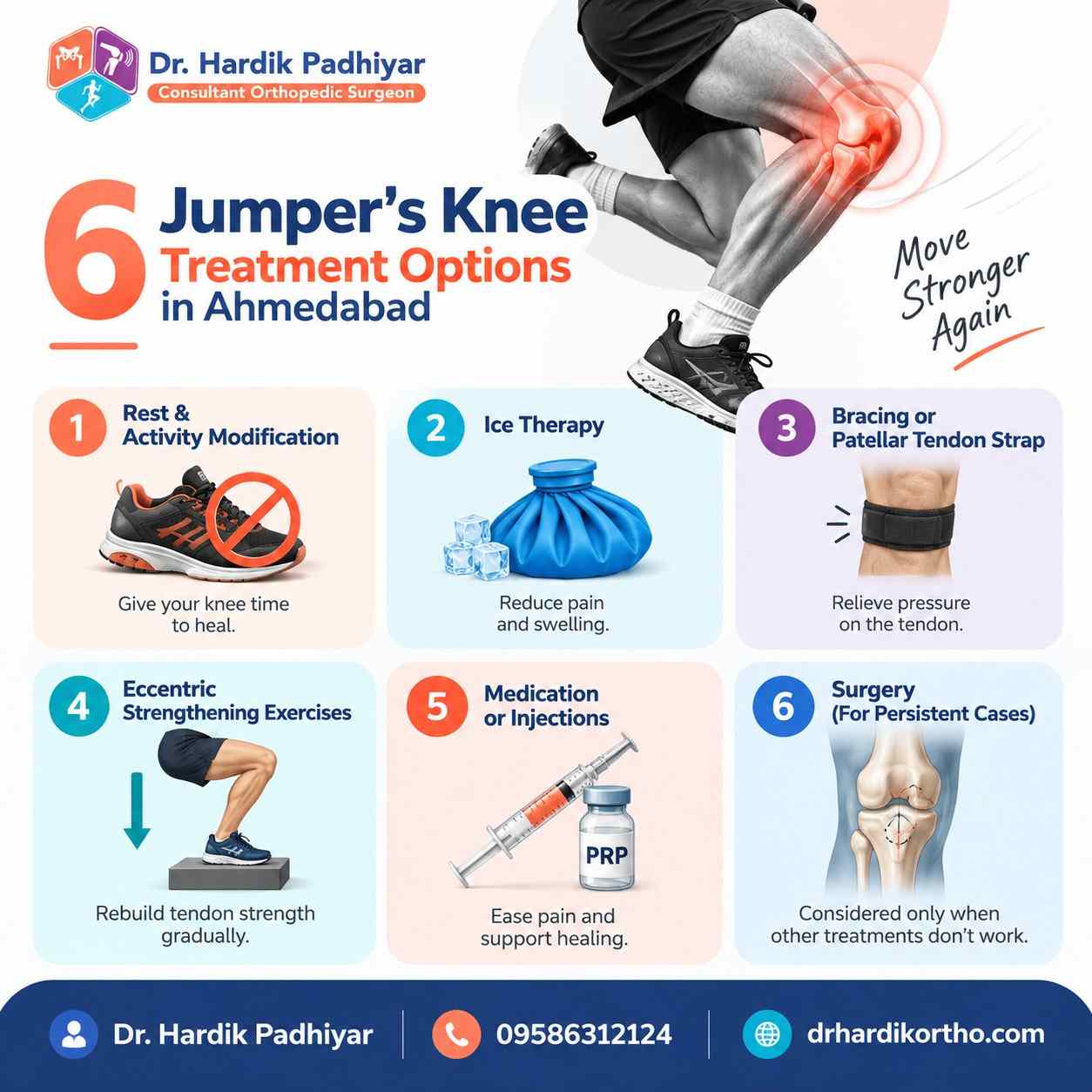
Here’s the order I typically walk patients through, starting with the least invasive.
1. Rest and activity modification.
This doesn’t mean stopping movement altogether. It means cutting back on the specific jumping or running load that’s aggravating the tendon while healing takes place.
2. Ice therapy.
Applying ice for 15 to 20 minutes after activity helps control the pain and swelling that builds up around an irritated tendon.
3. Bracing or a patellar tendon strap.
A strap worn just below the kneecap redistributes some of the load away from the irritated part of the tendon, which many patients find genuinely helpful during recovery.
4. Eccentric strengthening exercises.
This is the single most evidence-backed treatment for jumper’s knee. Slow, controlled exercises where the quadriceps lengthens under load, guided by a physiotherapist, gradually rebuild the tendon’s capacity to handle stress. This usually runs over 6 to 12 weeks.
5. Medication or injections.
Short courses of anti-inflammatory medication can ease acute pain, though they don’t fix the underlying tendon changes. For persistent cases, a platelet-rich plasma (PRP) injection can support tendon healing, and I’m upfront with patients that this works better as a support to strengthening exercises than as a standalone fix.
6. Surgery.
For the small number of patients whose pain doesn’t improve after 6 months or more of properly followed conservative treatment, surgical removal of damaged tendon tissue is an option. This is genuinely rare and only considered once every non-surgical avenue has had a fair trial.
If you’re active in the gym and this isn’t the first overuse issue you’ve dealt with, you may find our guide on gym injuries that need orthopaedic care useful for spotting other warning signs early.
What Can You Expect From Recovery?
Recovery timelines depend largely on how early treatment starts and how consistent you are with rehab:
- Mild cases caught early: improvement in 2 to 4 weeks with rest and load management
- Moderate cases needing structured rehab: 6 to 12 weeks of eccentric strengthening before returning to full activity
- Chronic cases with longstanding tendon changes: 3 to 6 months of consistent rehab, sometimes alongside injections
- Post-surgical cases: gradual return to sport over 4 to 6 months
I tell every patient the same thing: rushing back into jumping sports before the tendon has actually rebuilt its strength is the most common reason jumper’s knee becomes a recurring problem rather than a one-time injury.
When Should You See a Doctor for Knee Pain Below the Kneecap?
You should get it checked if:
- Pain has lasted more than 2 to 3 weeks despite rest and ice
- The pain is affecting your ability to walk, squat, or climb stairs normally
- You’ve noticed swelling around the tendon
- Pain is interfering with training or sport participation
- Symptoms keep returning every time you resume activity
Catching it early, before chronic tendon changes set in, generally means a faster and simpler recovery.
Conclusion
Jumper’s knee tends to creep in gradually, but it responds well to the right combination of rest, load management, and targeted strengthening. Surgery is rarely part of the picture, and most patients return to their sport fully once the tendon has properly rebuilt its strength.
Best Knee Replacement Surgeon in Ahmedabad
Ready to get it checked? If that ache below your kneecap has lasted more than a couple of weeks, contact us to book a consultation and get a clear recovery plan.
Frequently Asked Questions
Q: Can jumper’s knee heal on its own without treatment?
Mild cases sometimes settle with rest alone, but most benefit significantly from structured strengthening exercises. Ignoring ongoing pain often allows the tendon damage to progress into a more chronic problem.
Q: How long does jumper’s knee treatment take to work?
With consistent rehab, most people notice real improvement within 6 to 12 weeks. Chronic, longstanding cases can take several months of dedicated strengthening work.
Q: Can I keep playing sports with jumper’s knee?
Low-impact activity can usually continue, but jumping and sudden direction changes should be reduced or paused until the tendon has recovered enough strength, ideally under a physiotherapist’s guidance.
Q: Do I need surgery for jumper’s knee?
Rarely. The large majority of patients recover with structured conservative treatment, and surgery is reserved for the small percentage who don’t improve after months of proper rehab.
Q: Is jumper’s knee the same as a torn patellar tendon?
No. Jumper’s knee is tendon irritation and micro-damage from overuse, while a torn tendon is a more serious, sudden injury. If you feel a sudden pop or can’t straighten your knee at all, that needs urgent evaluation.
This article is for informational purposes only and does not replace a professional medical consultation. Every case of knee pain is different, and treatment should be guided by an in-person evaluation with a qualified orthopaedic specialist.