

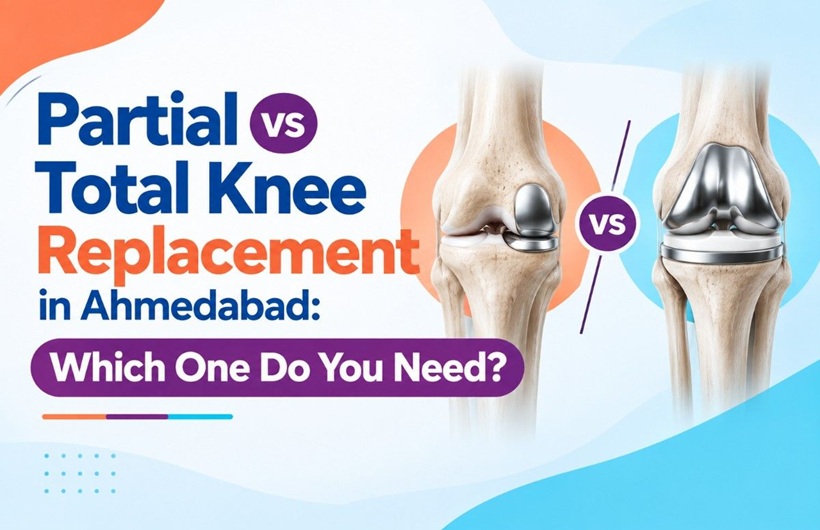
If you’ve been told your knee arthritis has reached the point where replacement surgery is on the table, one of the first questions patients ask me is whether they need a partial or a total knee replacement. It’s a fair question, and the honest answer is that it depends entirely on how much of your knee is actually damaged, not on your age or how bad the pain feels. If you’re weighing partial vs total knee replacement in Ahmedabad, as a practicing Orthopedic Doctor in Ahmedabad I want to walk you through exactly how this decision gets made.
What’s the Difference Between Partial and Total Knee Replacement?
Your knee has three compartments: the inner (medial), outer (lateral), and the one behind the kneecap (patellofemoral). Arthritis doesn’t always damage all three at once. Sometimes it’s isolated to just one area for years before it spreads, if it spreads at all.
Partial knee replacement, also called unicompartmental or unicondylar knee replacement, resurfaces only the damaged compartment. The healthy bone, cartilage, and ligaments elsewhere in the knee, including your ACL and PCL, are left untouched.
Total knee replacement resurfaces all three compartments. It’s the right choice when arthritis has spread across the joint or when the overall damage is too extensive for a partial approach to hold up long-term.
Neither option is inherently “better.” They’re suited to different patterns of damage, and the right one for you depends entirely on what your knee actually looks like on imaging, not on personal preference.
How Do I Know Which One I Need?
I make this decision using a combination of factors, and it’s rarely based on just one thing:
- Imaging findings. X-rays and sometimes an MRI show exactly which compartments are affected. If damage is confined to one area with healthy cartilage elsewhere, partial replacement becomes a real option.
- Ligament health. Partial knee replacement relies on your natural ACL and PCL for stability, so these need to be intact and functional.
- Extent and pattern of arthritis. Widespread arthritis across multiple compartments generally rules out a partial approach.
- Age and activity level. Younger, more active patients are often good partial candidates since it preserves more natural knee mechanics, though this isn’t a strict rule.
- Previous knee surgeries or deformities. Significant prior surgery or major knee deformity can shift the recommendation toward total replacement.
I always tell patients that this decision should come from a careful assessment, not a preference for the “smaller” surgery. A partial replacement performed on a knee that genuinely needs a total replacement tends to fail earlier and often needs revision surgery later.
Partial Knee Replacement: Benefits and Limitations
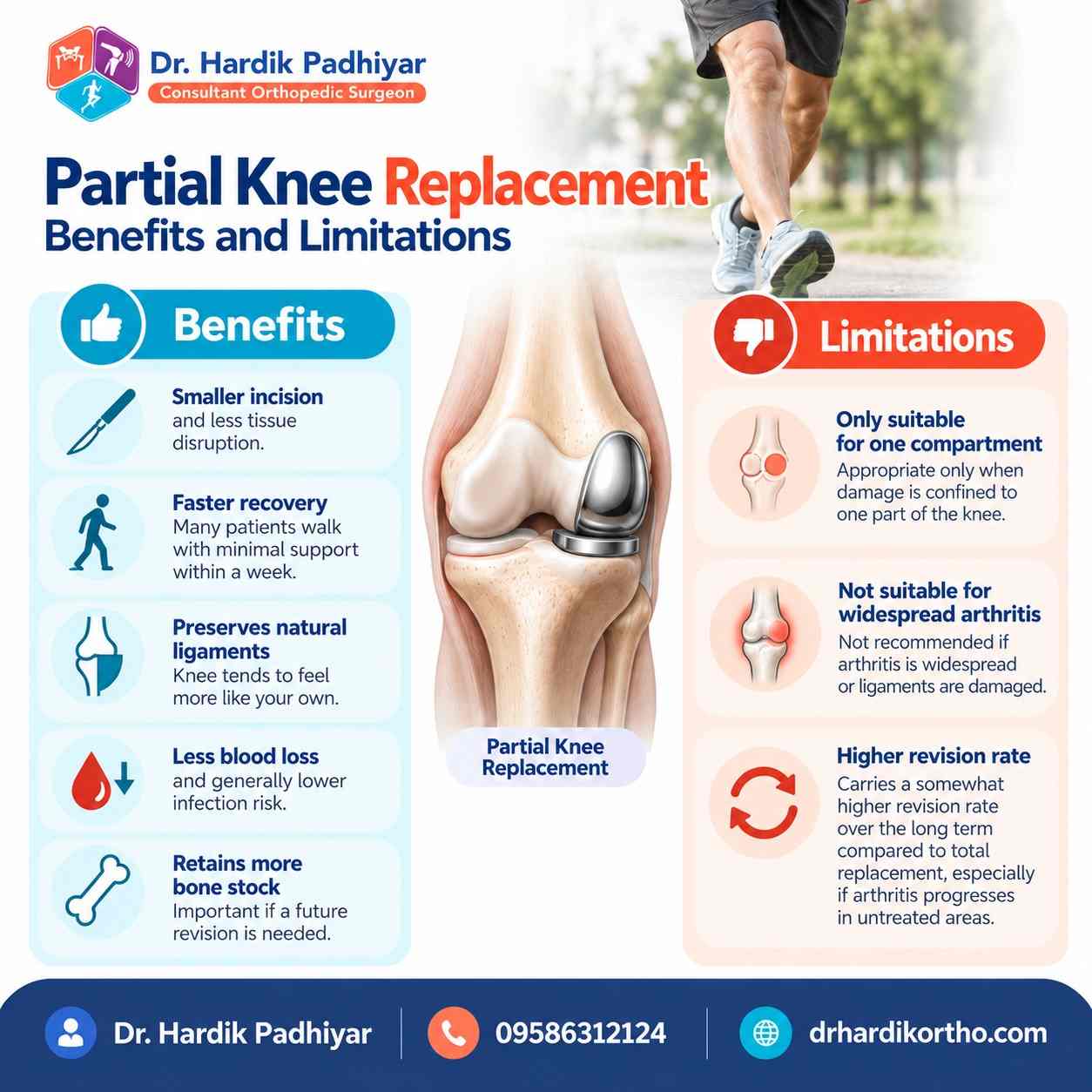
Benefits:
- Smaller incision and less tissue disruption
- Faster early recovery, many patients walk with minimal support within a week
- Preserves natural ligaments, so the knee tends to feel more like your own
- Less blood loss and generally lower infection risk due to reduced surgical exposure
- Retains more bone stock, which matters if a future revision to total replacement is ever needed
Limitations:
- Only appropriate for patients with damage confined to one compartment
- Not suitable if arthritis is widespread or ligaments are damaged
- Carries a somewhat higher revision rate over the long term compared to total replacement, particularly if arthritis progresses in the untreated compartments
If you’re curious about how this compares to another knee-preservation approach entirely, our guide on bone preservation versus removal in total knee replacement covers a related decision that comes up during total knee surgery itself.
Total Knee Replacement: Benefits and Limitations
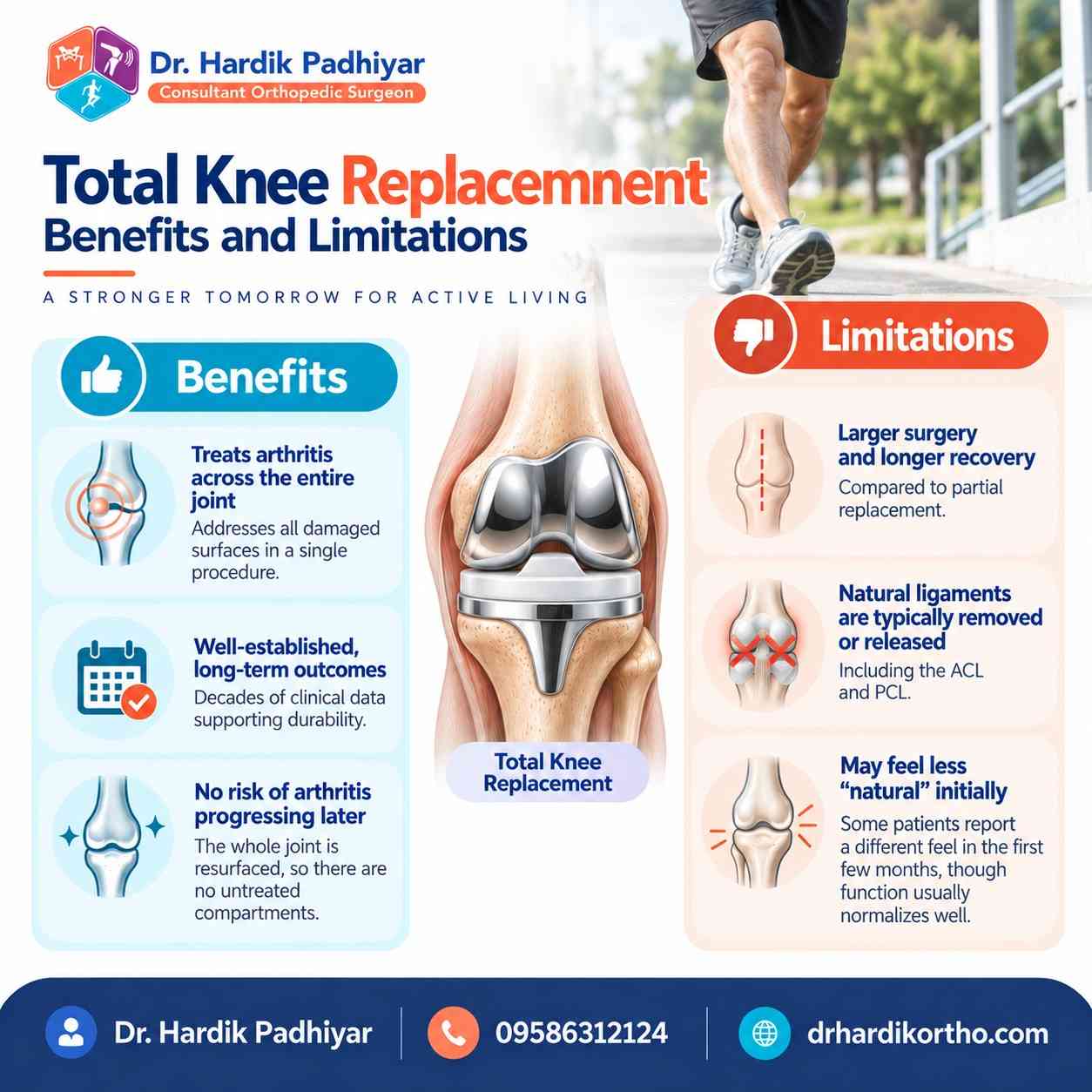
Benefits:
- Addresses arthritis across the entire joint in a single procedure
- Well-established, long-term outcomes with decades of clinical data supporting durability
- No risk of arthritis progressing in an untreated compartment later, since the whole joint is resurfaced
Limitations:
- Larger surgery with a longer initial recovery period compared to partial replacement
- Natural ligaments, including the ACL and PCL, are typically removed or released
- Some patients report the knee feeling less “natural” during the first several months, though function usually normalizes well
Our earlier guide on unicondylar knee replacement as a modern solution goes into more depth on how partial replacement fits into this picture for the right candidate.
Recovery: What’s Actually Different?
This is where patients often notice the clearest difference between the two:
- Walking independently: Around 1 week for partial replacement versus 1 to 2 weeks with a walking frame for total replacement
- Driving: Typically 4 to 6 weeks for partial versus around 6 weeks for total
- Return to light daily activity: Often 6 to 8 weeks for partial versus 3 to 4 months for total
- Full recovery and strength: Around 2 to 3 months for partial versus up to 6 months for total
Our detailed knee replacement recovery timeline breaks this down month by month if you want a fuller picture of what the total replacement path looks like specifically.
According to the American Academy of Orthopaedic Surgeons, patient selection is the single biggest factor in how well either procedure performs long-term, which is exactly why imaging and a proper clinical evaluation matter more than which surgery sounds less invasive.
Can a Partial Replacement Be Converted to a Total Replacement Later?
Yes, and this is one of the genuine advantages of starting with a partial replacement when you’re a good candidate. Because less bone is removed initially, converting to a total knee replacement later, if arthritis eventually progresses in the untreated compartments, is generally a more straightforward procedure than a typical revision surgery. It isn’t a downgrade or a wasted step; it’s a staged approach that keeps options open.
When Should You See a Doctor About Knee Replacement?
It’s worth a proper evaluation if:
- Knee pain persists despite medication, injections, or physiotherapy
- Pain or stiffness is limiting basic daily activities like stairs or getting up from a chair
- You’ve been told you might need knee replacement but aren’t sure which type applies to you
- You want a second opinion before committing to a specific surgical approach
Getting the right imaging and an honest assessment upfront is what actually determines whether partial or total is right for you, not guesswork.
Conclusion
Choosing between partial and total knee replacement isn’t about which surgery sounds less invasive. It comes down to exactly how much of your knee is damaged, confirmed through proper imaging and clinical evaluation. Both are well-established, successful procedures when matched to the right patient.
Best Knee Replacement Surgeon in Ahmedabad
Ready to find out which option fits your knee? Contact us to book a consultation and get a clear recommendation based on your imaging.
Frequently Asked Questions
Q: Is partial knee replacement less painful than total knee replacement?
A: Both involve post-surgical discomfort that’s well managed with medication, but partial replacement generally involves less tissue disruption, which often means a somewhat easier initial recovery period.
Q: Can I choose partial knee replacement even if my surgeon recommends total?
A: This decision should be based on your actual imaging and ligament health, not preference. If arthritis has spread beyond one compartment, a partial replacement is unlikely to hold up well long-term.
Q: How long does a partial knee replacement last?
A: In well-selected patients, partial knee replacements can last 15 years or longer, with survival rates comparable to total knee replacement. Patient selection is the key factor.
Q: Does total knee replacement last longer than partial?
A: Overall, total knee replacements have a slightly lower revision rate long-term, mainly because there’s no remaining compartment where arthritis can progress. Both are considered durable, successful procedures in the right patients.
Q: Will my knee feel normal after either surgery?
A: Most patients regain excellent function with both procedures. Partial replacement tends to feel more like a natural knee since your ligaments are preserved, while total replacement patients typically adjust well within a few months.
This article is for informational purposes only and does not replace a professional medical consultation. Every case of knee arthritis is different, and treatment should be guided by an in-person evaluation with a qualified orthopaedic specialist.