

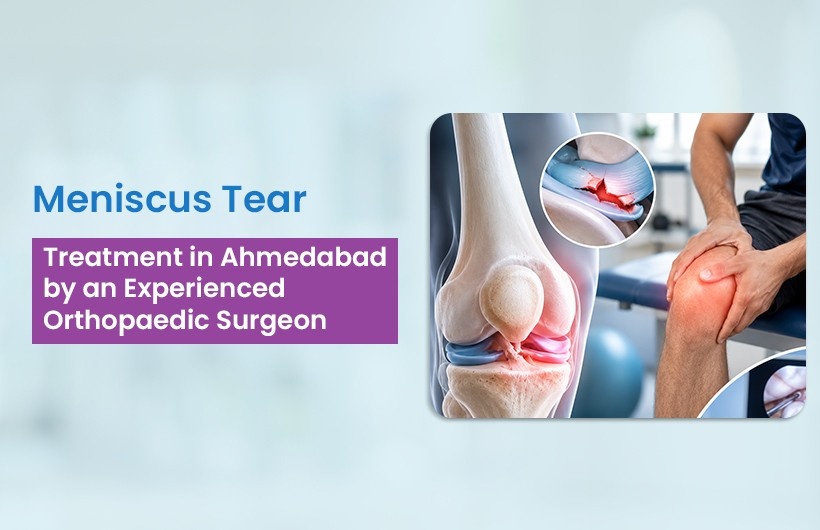
That clicking or locking sensation in your knee after a twist, a missed step, or a weekend game of cricket isn’t something to wait out. It could be a torn meniscus, and how you handle it in the first few weeks often decides how your knee feels years from now.
As part of meniscus tear treatment at our clinic, we see this injury constantly, in athletes who twisted awkwardly mid-game, and in patients over 50 whose meniscus simply wore thin with age. If you’re searching for a best orthopaedic doctor in Ahmedabad to make sense of your knee pain, here’s what you need to know.
What Is a Meniscus Tear?
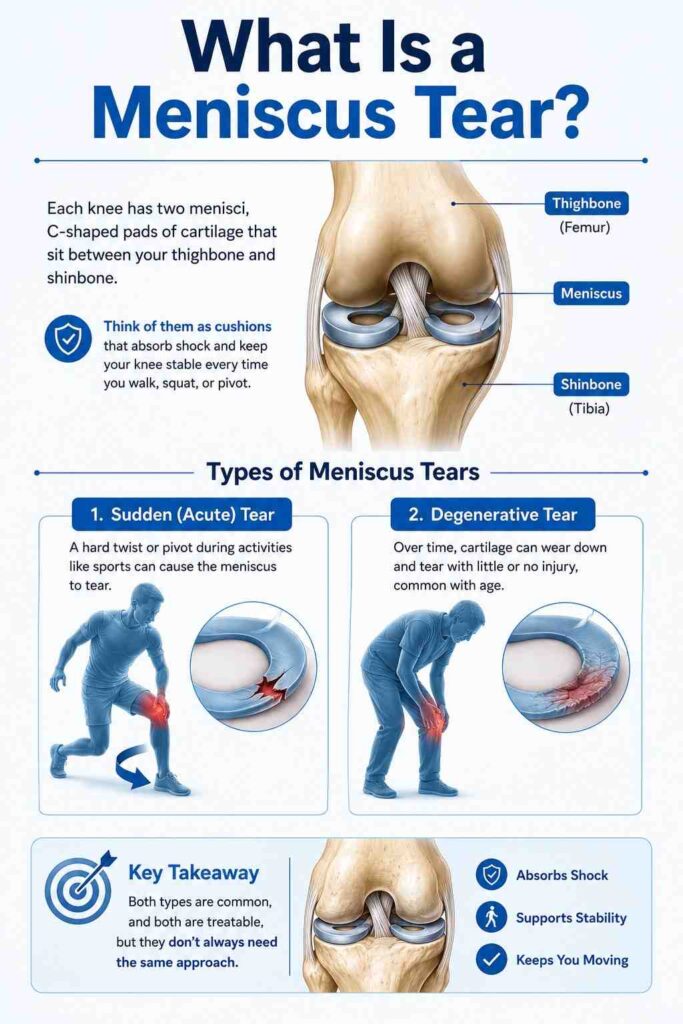
Each knee has two menisci, C-shaped pads of cartilage that sit between your thighbone and shinbone. Think of them as cushions that absorb shock and keep your knee stable every time you walk, squat, or pivot.
A tear happens when that cartilage is damaged, either suddenly (a hard twist during sport) or gradually (cartilage that’s thinned out with age and tears with minimal force). Both types are common, and both are treatable, but they don’t always need the same approach.
What Causes a Torn Meniscus?
Most tears fall into one of two categories.
Traumatic tears happen during sudden twisting or pivoting movements, common in football, cricket, and badminton, especially when the foot stays planted while the knee turns. A hard fall or a direct blow to the knee can also tear the cartilage.
Degenerative tears develop over time. As we age, the meniscus loses water content and elasticity, becoming brittle. At that point, even a simple squat or an awkward step off a curb can tear it.
Some patients tear the meniscus alongside a ligament, most often the ACL. If your knee felt unstable or gave way now of injury, rather than just locking or catching, it’s worth reading how a meniscus tear compares to an ACL tear, since the two often get confused.
What Are the Warning Signs?
A torn meniscus usually announces itself clearly. Watch for:
- Pain along the inner or outer edge of the knee, especially when twisting or squatting
- Swelling that builds up over several hours after the injury
- A popping sensation now of injury
- Stiffness that limits how far you can bend or straighten the knee
- Your knee catching, clicking, or locking in one position
That locking sensation deserves particular attention; a torn flap of cartilage can physically jam the joint. We’ve covered this in detail in our guide to knee locking causes, which is worth reading if this symptom sounds familiar.
Do You Need Surgery, or Will Rest Work?
This is the question almost every patient asks first, and the honest answer is: it depends on where the tear is and how big it is.
Non-surgical care works well when:
- The tear is small and located in the outer third of the meniscus, where blood supply is better
- Symptoms are mild, some discomfort, but no locking or giving-way
- The patient is willing to modify activity and commit to physiotherapy
In these cases, we typically recommend rest, activity modification, anti-inflammatory medication, and a structured physiotherapy program focused on strengthening the muscles around the knee. Many patients see meaningful improvement within 4 to 6 weeks without surgery.
Surgery becomes the better option when:
- The tear is large, complex, or located in the inner two-thirds of the meniscus, where healing on its own is unlikely
- The knee is locking or catching repeatedly
- Symptoms haven’t improved after several weeks of conservative treatment
- The patient is young and active, and preserving long-term knee function matters
Dr. Hardik Padhiyar’s approach follows a “save the meniscus first” philosophy, repairing the torn tissue with sutures whenever the tear pattern allows, rather than removing it. Removing part of the meniscus (a partial meniscectomy) is sometimes unavoidable for complex or degenerative tears, but repair, when possible, preserves more of the knee’s natural shock absorption and reduces the long-term risk of arthritis.
What to Expect: Meniscus Tear Recovery Timeline
Recovery depends heavily on whether the tear was repaired or partially removed.
| Recovery Stage | Meniscus Repair | Partial Meniscectomy |
|---|---|---|
| Weight-bearing | Limited, with brace, for 4–6 weeks | Full weight-bearing within days |
| Return to daily activities | 4–6 weeks | 2–4 weeks |
| Return to light exercise | 8–12 weeks | 4–6 weeks |
| Return to full sport | 4–6 months | 6–8 weeks |
Repair takes longer because the sutured tissue needs time to heal biologically, rushing this stage risks a re-tear. Meniscectomy recovery is faster since there’s no tissue waiting to knit back together, but it does mean less of the natural cushion remains in the knee long-term.
Physiotherapy is not optional in either case. It’s what restores strength, flexibility, and confidence in the joint, skipping it is the single biggest reason patients end up back in the clinic with ongoing symptoms.
If your knee pain, swelling, or locking has lasted more than a couple of weeks, it’s worth getting an MRI and a proper evaluation rather than guessing. You can call us at +91 79903 83550 to arrange a consultation and imaging.
The Bottom Line
A locking or clicking knee isn’t something to push through for weeks on end. Whether your meniscus tear needs rest and physiotherapy or a repair, catching it early gives you the most options, including preserving the meniscus itself rather than losing part of it.
If your knee has been catching, swelling, or bothering you longer than it should, contact us to book an evaluation with Dr. Hardik Padhiyar and get a clear plan for your recovery.
Meet Dr. Hardik, Your Trusted Orthopedic Specialist
If you’re experiencing knee pain, hip pain, shoulder pain, sports injuries, fractures, arthritis, or any bone and joint concerns, get expert guidance from Dr. Hardik Padhiyar and explore the right treatment options today.
Frequently Asked Questions
Q: Can a meniscus tear heal on its own without surgery?
A: Small tears in the outer, well-supplied part of the meniscus can improve with rest and physiotherapy. Tears in the inner two-thirds usually need surgical repair, since that area has poor blood supply.
Q: How painful is meniscus tear surgery, and is it a big operation?
A: It’s typically done arthroscopically, through small keyhole incisions. Most patients go home the same day, and post-operative pain is well managed with medication.
Q: What happens if a torn meniscus is left untreated?
A: Untreated tears can worsen over time, leading to persistent locking, cartilage damage, and a higher risk of early osteoarthritis in the knee.
Q: Can I still play sports after a meniscus tear?
A: Yes, in most cases. After meniscus repair, athletes typically return to sport in 4 to 6 months; after a meniscectomy, often within 6 to 8 weeks, depending on healing.
Q: Is meniscus repair better than removing the torn part?
A: When the tear pattern allows it, repair is generally preferred because it preserves more natural cartilage and lowers long-term arthritis risk. Not every tear is repairable, though, it depends on location and pattern.
This article is for informational purposes only and does not constitute medical advice. Please consult an orthopaedic surgeon for diagnosis and treatment specific to your condition.