


If you feel a nagging ache or stiffness at the back of your heel that flares up during or after a run, a gym session, or even a long walk, you’re likely dealing with Achilles tendinitis. It’s one of the most common overuse injuries I see in runners and gym-goers, and the reassuring part is that it’s very different from a torn tendon. If you’re researching Achilles tendinitis treatment in Ahmedabad, as one of the trusted orthopaedic doctors in Ahmedabad, I want to explain what’s actually happening in your tendon, the 6 recovery steps I recommend, and when this pain needs more than just rest.
What Is Achilles Tendinitis?
The Achilles tendon is the thick band of tissue connecting your calf muscles to your heel bone. It’s the tendon you rely on every time you push off the ground while walking, running, or jumping, which means it absorbs a significant amount of load with every step.
Achilles tendinitis develops when this tendon is repeatedly stressed faster than it can recover. Small amounts of irritation and microscopic damage build up in the tendon fibers, leading to pain, stiffness, and sometimes mild swelling around the back of the ankle.
This is different from an Achilles tendon tear or rupture, which is a sudden, more serious injury often accompanied by a pop or snap and an inability to push off the foot. Tendinitis, by contrast, builds gradually and rarely stops you from walking altogether, though it can certainly slow you down.
What Causes Achilles Tendinitis?
In my practice, a few patterns come up again and again:
- A sudden increase in running distance, speed, or hill training
- Switching to a new sport or exercise routine too quickly
- Tight calf muscles or limited ankle flexibility
- Worn-out or unsupportive footwear
- Training on hard surfaces without adequate recovery time
- Being over 30, since tendons naturally lose some elasticity with age
According to the American Academy of Orthopaedic Surgeons, Achilles tendinitis is especially common among “weekend warriors,” people who increase the intensity or frequency of their activity suddenly, without building up to it gradually.
How Do You Know It’s Achilles Tendinitis?
The symptoms are usually fairly consistent and easy to recognize:
- A dull ache or burning sensation at the back of the heel or lower calf
- Stiffness that’s often worse first thing in the morning
- Pain that increases with running, jumping, or climbing stairs
- Mild swelling or thickening along the tendon
- Tenderness when the area is pressed
I typically diagnose Achilles tendinitis through a physical exam, checking tenderness, swelling, and range of motion at the ankle. An ultrasound or MRI is occasionally used in more chronic or unclear cases to assess how much degeneration has developed in the tendon, especially if there’s any suspicion of a partial tear.
6 Achilles Tendinitis Treatment Options in Ahmedabad
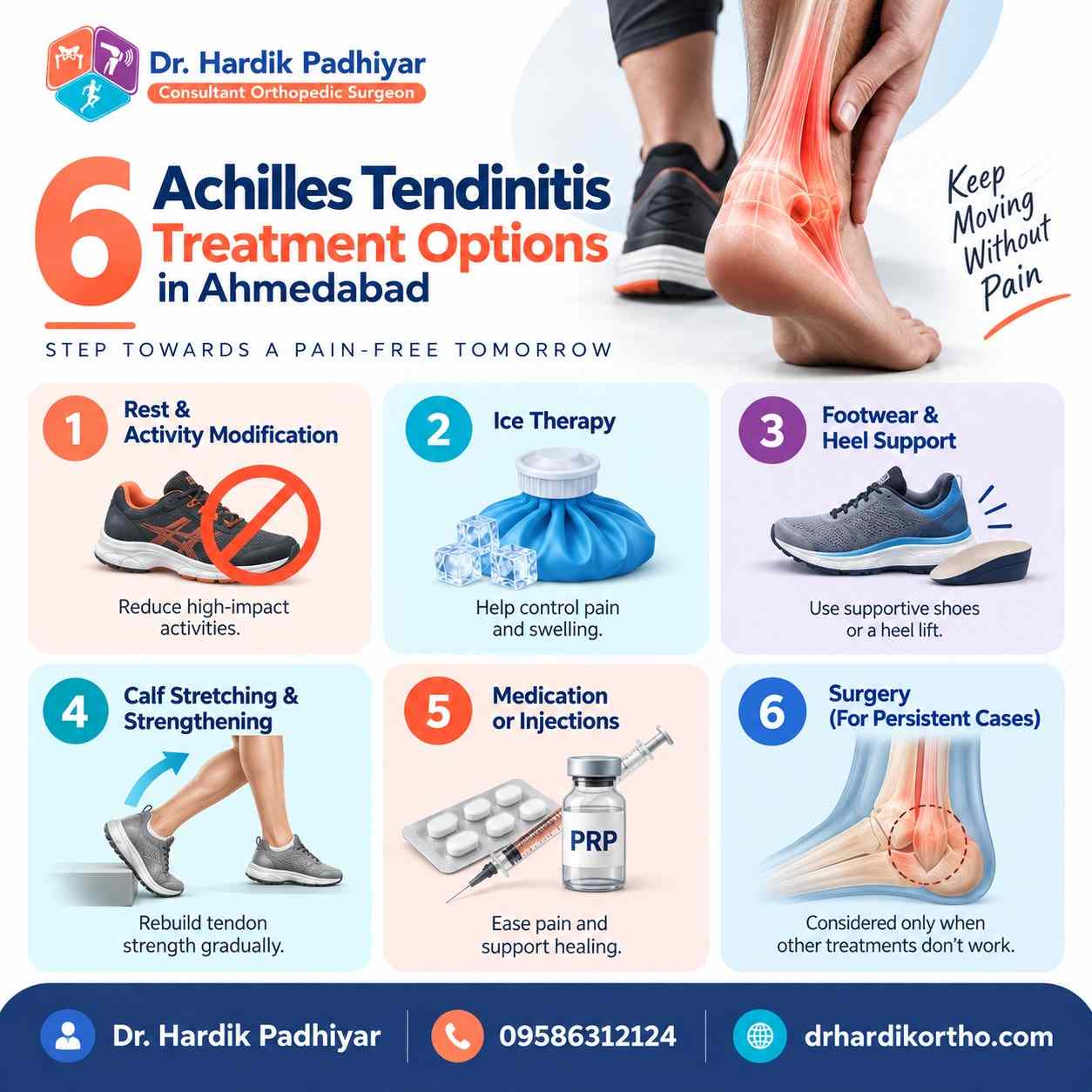
Here’s the order I usually work through with patients, starting with the least invasive approach.
1. Rest and activity modification. This doesn’t mean stopping movement completely. It means cutting back on the running or jumping load that’s aggravating the tendon while it settles down.
2. Ice therapy. Applying ice for 15 to 20 minutes after activity helps control pain and swelling in the early stages.
3. Footwear and heel support. A small heel lift or supportive, cushioned running shoes reduce strain on the tendon during daily activity and light exercise.
4. Calf stretching and eccentric strengthening. This is the most evidence-backed treatment for Achilles tendinitis. Slow, controlled calf-lowering exercises, guided by a physiotherapist, gradually rebuild the tendon’s capacity to handle load. This typically runs over 8 to 12 weeks.
5. Medication or injections. Short courses of anti-inflammatory medication can ease acute pain, though steroid injections directly into the Achilles tendon are generally avoided since they can weaken the tendon further. In select chronic cases, a platelet-rich plasma (PRP) injection may support healing alongside a structured rehab program.
6. Surgery. For the small percentage of patients who don’t improve after 6 months or more of consistent conservative treatment, or in cases where degeneration is significant, surgical removal of damaged tendon tissue is an option. This is genuinely uncommon and reserved for cases that don’t respond to proper rehab.
If you’re training regularly and this isn’t your first overuse complaint, our guide on jumper’s knee treatment covers a similar tendon-overload pattern lower down the leg, and our orthopedic tips for runners can help you spot other early warning signs before they become injuries.
What Can You Expect From Recovery?
Recovery timelines depend on how early treatment starts and how consistent you are with rehab:
- Mild cases caught early: noticeable improvement in 2 to 4 weeks with rest and load management
- Moderate cases needing structured rehab: 8 to 12 weeks of calf strengthening before returning to full training
- Chronic cases with longstanding tendon changes: 3 to 6 months of consistent rehab, sometimes with injections
- Post-surgical cases: gradual return to running over 4 to 6 months
One thing I always emphasize: returning to intense training before the tendon has genuinely rebuilt its strength is the main reason Achilles tendinitis keeps coming back instead of resolving fully. If you’ve dealt with shin discomfort alongside this, it’s worth ruling out overlapping issues, which our guide on shin splints explains in more detail.
When Should You See a Doctor for Heel or Calf Pain?
You should get it evaluated if:
- Pain has lasted more than 2 to 3 weeks despite rest and ice
- You notice a sudden sharp pain, pop, or snap at the back of the ankle
- The tendon feels thickened, lumpy, or significantly swollen
- Pain is affecting your ability to walk normally
- Symptoms keep returning every time you resume training
Catching it early, before chronic tendon changes set in, generally means a simpler and faster recovery.
Conclusion
Achilles tendinitis tends to build up gradually, but it responds well to the right combination of rest, calf strengthening, and load management. Surgery is rarely part of the picture, and most patients return to running or their sport once the tendon has properly rebuilt its capacity.
Best Orthopedic surgeon in Ahmedabad
Ready to get it checked? If that heel or calf ache has lasted more than a couple of weeks, contact us to book a consultation and get a clear recovery plan.
Frequently Asked Questions
Q: Can Achilles tendinitis heal on its own without treatment?
A: Mild cases sometimes settle with rest alone, but most benefit significantly from calf strengthening and load management. Ongoing pain that’s ignored can progress toward more serious tendon degeneration.
Q: Is Achilles tendinitis the same as a torn Achilles tendon?
A: No. Tendinitis is gradual overuse irritation of the tendon, while a tear is a sudden, more serious injury often marked by a pop and an inability to push off the foot. A tear needs urgent evaluation.
Q: How long does Achilles tendinitis treatment take to work?
A: With consistent rehab, most people notice real improvement within 8 to 12 weeks. Chronic, longstanding cases can take several months of dedicated calf strengthening.
Q: Can I keep running with Achilles tendinitis?
A: Light, low-impact activity can sometimes continue, but running and jumping should usually be reduced or paused until the tendon regains strength, ideally under a physiotherapist’s guidance.
Q: Do I need surgery for Achilles tendinitis?
A: Rarely. The large majority of patients recover with structured conservative treatment, and surgery is reserved for the small percentage who don’t improve after months of proper rehab.
This article is for informational purposes only and does not replace a professional medical consultation. Every case of Achilles pain is different, and treatment should be guided by an in-person evaluation with a qualified orthopaedic specialist.