
That pop you heard during a football match or a bad landing on the basketball court wasn’t your imagination. If your knee buckled right after, gave way when you tried to stand, or swelled up within hours, there’s a good chance you’ve torn your ACL.
I see this injury often in active patients across Ahmedabad- runners, weekend cricketers, gym-goers who pivoted wrong on a squat. If you’re facing ACL reconstruction surgery, I’d rather give you the real picture than a polished brochure version. As Dr. Hardik Padhiyar, I want you to walk into this surgery knowing exactly what’s ahead.
What Is the ACL, and Why Does It Tear?
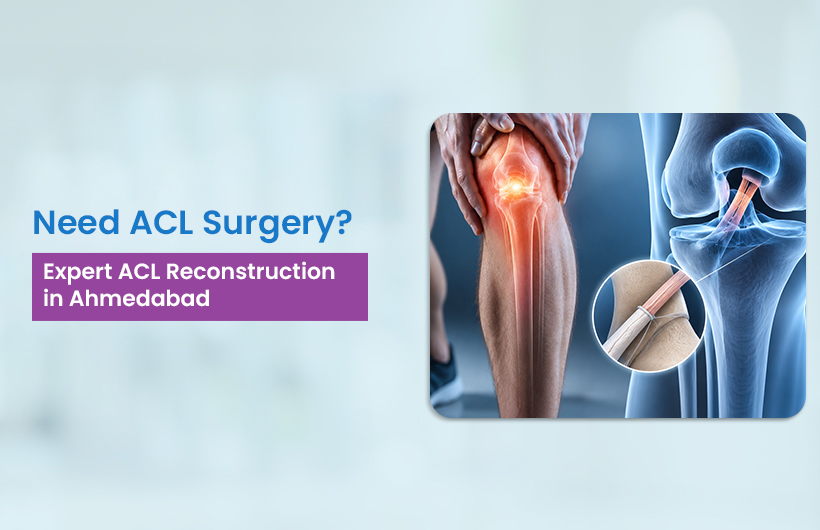
The anterior cruciate ligament (ACL) is one of four major ligaments that stabilize your knee. It sits deep inside the joint, connecting your thighbone to your shinbone, and its main job is preventing your shin from sliding too far forward relative to your thigh.
Most ACL tears happen without contact. A sudden stop, a pivot, or an awkward landing puts more rotational force on the knee than the ligament can handle. Contact injuries, like a direct hit to the side of the knee during football or kabaddi, account for the rest.
Once an ACL is fully torn, it doesn’t heal back on its own the way a sprained muscle might. Unlike PCL injuries, which are often less severe and more likely to respond to non-surgical care, a complete ACL tear in an active person usually needs reconstruction if you want your knee to feel stable again during sport or sharp directional movement. If you’re not sure which ligament is involved, our PCL vs ACL injuries guide walks through how to tell them apart.
How Do I Know If I’ve Torn My ACL?
The classic signs patients describe to me are:
- A loud pop now of injury
- Immediate swelling, usually within 2 to 4 hours
- A feeling that the knee “gives way” or can’t bear weight
- Pain along the joint line, worse with twisting movements
- Reduced range of motion within the first day or two
Not every twisted knee is an ACL tear. Sprains, meniscus injuries, and other ligament damage can feel similar at first. That’s why I always confirm with a physical exam (the Lachman test is the most reliable one) plus an MRI before recommending surgery. I’d rather spend a week confirming the diagnosis than operate on the wrong assumption.
Do You Always Need Surgery for a Torn ACL?
Not always, and I’ll be honest with you about this upfront. If you’re not planning to return to pivoting sports, are older, or have a partial tear with a stable knee, physiotherapy and bracing can sometimes be enough. Some patients manage well long-term with strengthened hamstrings and quadriceps compensating for the lost stability.
But if you’re young, athletic, or your knee keeps giving way during daily activity, reconstruction is usually the better path. An unstable knee left untreated increases your risk of further cartilage and meniscus damage over time. I’ve seen patients who delayed surgery come back a year later with additional tears that could have been avoided.
How Is ACL Reconstruction Performed?
ACL reconstruction is done arthroscopically through small keyhole incisions rather than an open cut. I use a camera and fine instruments to remove the torn ligament remnant and replace it with a graft, most taken from your own hamstring tendon or patellar tendon.
The graft is threaded through small tunnels drilled in the thighbone and shinbone, then secured with screws or fixation devices. The surgery typically takes 1 to 1.5 hours, and most patients go home the same day or the next morning.
This isn’t a procedure where “more advanced” automatically means “better for you Graft choice depends on your activity level, age, and anatomy, and that’s a conversation we have together before surgery, not a one-size-fits-all decision.
What Should I Expect During Recovery?
Recovery from ACL reconstruction is a marathon, not a sprint, and I tell every patient this directly because too many websites gloss over it.
Weeks 1-2: Focus is on reducing swelling and regaining basic knee extension. You’ll likely use crutches and braces.
Weeks 3-6: Physiotherapy ramps up, restoring range of motion and beginning light strengthening. Most patients walk without crutches by weeks 4 to 6.
Months 2–4: Focus on progressive strength training, balance exercises, and low-impact activities such as cycling or swimming.
Between months 5 and 9, sport-specific drills can be introduced, but only after strength testing confirms that the operated leg is nearly as strong as the unoperated one.
By months 9–12, most patients can return fully to pivoting sports. This is where I must be honest with those who want to accelerate the process. Studies consistently show that returning before the 9-month mark significantly increases the risk of re-tearing the graft. I’d rather you be frustrated by the timeline than find yourself back in my operating room for a second surgery.
What Are the Risks and Limitations?
Every surgery carries risk, and ACL reconstruction is no exception. These include infection, stiffness, graft failure, and in rare cases, ongoing instability. The success rate for returning to prior activity level is high, generally cited around 80 to 90% for athletic patients who complete full rehabilitation, but that number depends heavily on how disciplined you are with physiotherapy afterward. Surgery gets your ligament back; rehab gets your knee back.
When Should You See a doctor?
If your knee swelled within hours of an injury, gave way while walking, or you can’t fully straighten or bend it after a day or two, don’t wait it out. Early diagnosis means we can plan surgery before secondary damage to your cartilage or meniscus sets in, which generally means a smooth recovery.
Conclusion
A torn ACL can feel like it’s derailing your active life, but with the right diagnosis, a well-planned reconstruction, and honest commitment to rehab, most patients do return to the activities they love. The key is not rushing any part of the process from diagnosis to surgery to that final return-to-sport clearance.
If your knee has been giving way or you’re dealing with persistent swelling after an injury, don’t wait for it to get worse. Contact us to schedule an evaluation, or call us at +91 79903 83550 to discuss your symptoms directly.
Frequently Asked Questions
Q: Can a torn ACL heal without surgery?
A: A complete tear won’t reattach on its own, but some patients with low activity demands manage well with physiotherapy and bracing instead of surgery.
Q: How long does ACL reconstruction surgery take?
A: The procedure itself typically takes 1 to 1.5 hours, and most patients are discharged the same day or the following morning.
Q: When can I walk again after ACL surgery?
A: Most patients are off crutches and walking independently within 4 to 6 weeks, though full strength takes much longer.
Q: Is ACL reconstruction painful?
A: There is discomfort in the first few days, managed with pain medication, but it’s generally less painful than patients expect, given it’s a keyhole procedure.
Q: Can I play sports again after ACL surgery?
A: Most athletic patients return to their sport, but typically not before 9 to 12 months, once strength testing confirms the knee is ready.
Q: What’s the difference between ACL and PCL injuries?
A: They’re different ligaments with different mechanisms of injury; see our detailed comparison for symptoms and treatment differences.
This article is for general informational purposes and does not replace medical consultation. Every knee injury is different, and treatment recommendations should be based on your individual examination and imaging.