

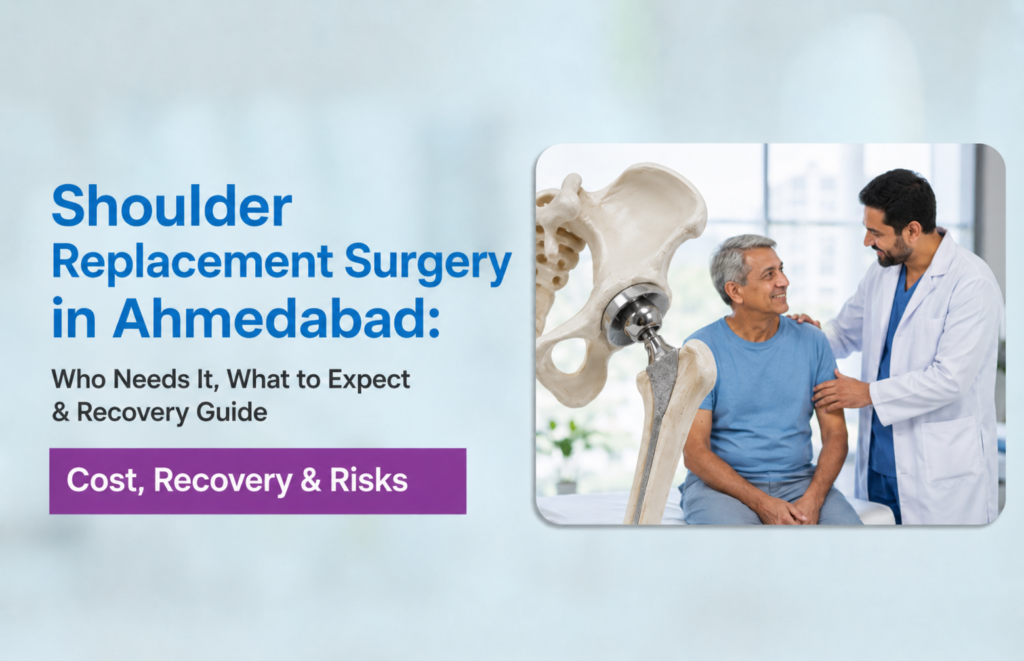
Shoulder pain that doesn’t go away even after months of physiotherapy, injections, or medication can completely take over your life. Simple things like reaching for a glass, combing your hair, or sleeping on your side become painful challenges. If this sounds familiar, shoulder replacement surgery in Ahmedabad may be the solution you have been looking for. As a Best Orthopedic Doctor in Ahmedabad, Gujarat, I have helped hundreds of patients regain pain-free movement and get back to the life they deserve.
Table of Contents
ToggleWhat Is Shoulder Replacement Surgery?
Shoulder replacement surgery, also called shoulder arthroplasty, is a procedure where the damaged parts of the shoulder joint are replaced with artificial implants. The shoulder is a ball-and-socket joint. When the cartilage wears away due to arthritis, injury, or disease, the bones rub against each other, causing severe pain and loss of movement.
The surgery replaces the damaged ball (head of the humerus) and sometimes the socket (glenoid) with high-quality prosthetic components. This eliminates the bone-on-bone friction and restores smooth, comfortable movement.
Types of Shoulder Replacement
There are three main types, and the right one depends on your specific condition:
- Total Shoulder Replacement: Both the ball and socket are replaced. Best for patients with osteoarthritis and an intact rotator cuff.
- Partial Shoulder Replacement (Hemiarthroplasty): Only the ball is replaced. Used when the socket is still in good condition.
- Reverse Total Shoulder Replacement: The ball and socket positions are switched. This is specifically for patients with severe rotator cuff tears where a standard replacement won’t work.
Who Needs Shoulder Replacement Surgery?
Not everyone with shoulder pain needs surgery. But there are clear signs that it may be time to consider it.
You may be a good candidate if you have:
- Severe osteoarthritis of the shoulder that limits daily activity
- Rheumatoid arthritis: which has significantly damaged the joint
- Avascular necrosis: where the bone tissue dies due to poor blood supply
- Rotator cuff tear arthropathy: a combination of massive rotator cuff tear and arthritis
- Failed previous shoulder surgery: where the joint has deteriorated further
- Chronic pain that has not improved after 6:12 months of non-surgical treatment
If you have tried physiotherapy, pain medications, cortisone injections, and still find no lasting relief, it may be time for a detailed consultation.
How Is the Procedure Performed?
The surgery typically takes 1.5 to 2 hours under general or regional anesthesia. Here is what happens step by step:
- Anesthesia: You are given anesthesia, so you feel no pain during the procedure. To understand the types of anaesthesia used in orthopaedic surgery, read this guide on anaesthesia in orthopaedic surgery.
- Incision: A small incision is made at the front of the shoulder to access the joint.
- Removal of damaged bone: The damaged ball and socket surfaces are carefully removed.
- Implant placement: The artificial components are fitted and secured in place.
- Closure: The incision is closed, and a drain may be placed to prevent fluid build-up.
Most patients are up and moving the same day or the next morning. Hospital stay is usually 2:3 days.
Shoulder Replacement Recovery: What to Expect
Recovery is gradual and requires patience, but the results are worth it. Here is a realistic timeline:
Week 1:2: Rest and Protection
Your arm will be in a sling. Swelling and discomfort are normal. Gentle pendulum exercises are started in the hospital to prevent stiffness.
Week 3:6: Physiotherapy Begins
A structured physiotherapy program starts. The focus is on restoring the range of motion, lifting your arm forward, sideways, and rotating gently.
Week 6:12: Strength Returns
As healing progresses, light strengthening exercises are introduced. Most patients can handle basic daily tasks like eating, dressing, and light household work.
Month 3:6: Major Improvement
By this stage, most patients report significant pain relief and improved function. Many return to driving and desk work around the 3-month mark.
6 Months to 1 Year: Full Recovery
Heavy lifting, sports, and strenuous activities are gradually resumed. With consistent physiotherapy, patients can expect 90:95% restoration of shoulder function.
Life After Shoulder Replacement Surgery
Most patients are amazed at the difference surgery makes to their quality of life. Here is what you can realistically expect after a full recovery:
- Sleeping comfortably on the operated side (after 3:4 months)
- Reaching overhead without sharp pain
- Returning to light sports like swimming or golf (after 6+ months, as advised)
- Performing daily tasks without relying on others
- Reduced dependence on painkillers
The implants used today are designed to last 15:20 years for most patients. Regular follow-ups help ensure the implant remains stable and functions well.
Why Choose Dr. Hardik Padhiyar for Shoulder Replacement in Ahmedabad?
Dr. Hardik Padhiyar is a leading joint replacement and orthopedic surgeon based at AB Plus Hospital, SG Highway, Ahmedabad. He has advanced training in shoulder arthroplasty techniques and has performed successful shoulder replacement surgeries for patients across Gujarat and neighboring states.
His approach is always patient first. He takes the time to explain every aspect of the procedure, discuss realistic expectations, and guide patients through every step of recovery. The use of high-quality implants combined with a structured rehabilitation protocol ensures the best possible outcomes for each patient.
If you are experiencing chronic shoulder pain, getting the right diagnosis early can make a significant difference. Understanding the difference between joint pain and other types of discomfort is an important first step. Learn more about joint pain vs. muscle pain to help you identify your symptoms.
Ready to Say Goodbye to Shoulder Pain?
If shoulder pain is limiting your daily life and non-surgical treatments have not provided lasting relief, it may be time to explore your options. I would be happy to assess your condition, review your scans, and discuss whether shoulder replacement surgery in Ahmedabad is the right step for you.
Book an appointment today, or WhatsApp us to ask a question directly. We are always happy to help.
Frequently Asked Questions
Q: How long does shoulder replacement surgery take?
A: The procedure typically takes 1.5 to 2 hours. Hospital stay is usually 2 to 3 days, after which most patients return home and begin physiotherapy.
Q: Is shoulder replacement surgery painful?
A: There is some discomfort in the first 1:2 weeks, which is managed well with prescribed medications. The surgery itself is painless since you are under anesthesia. Most patients find the post-surgical discomfort far less than the chronic pain they lived with before.
Q: At what age can someone have shoulder replacement surgery?
A: There is no fixed age limit. Most patients are between 50 and 80 years old, but younger patients with severe joint damage may also be candidates. The decision is based on the condition of the joint and overall health.
Q: How long do shoulder replacement implants last?
A: Modern shoulder implants are designed to last 15:20 years for most patients. Avoiding heavy manual labor and following post-surgery advice helps maximize the implant’s lifespan.
Q: Can both shoulders be replaced?
A: Yes, but not at the same time. If both shoulders require replacement, the surgeries are usually scheduled several months apart to allow for safe recovery.
Q: What are the risks of shoulder replacement surgery?
A: As with any surgery, there are risks such as infection, blood clots, nerve injury, or implant loosening over time. These are uncommon. An experienced surgeon and proper post-operative care significantly reduce these risks.