

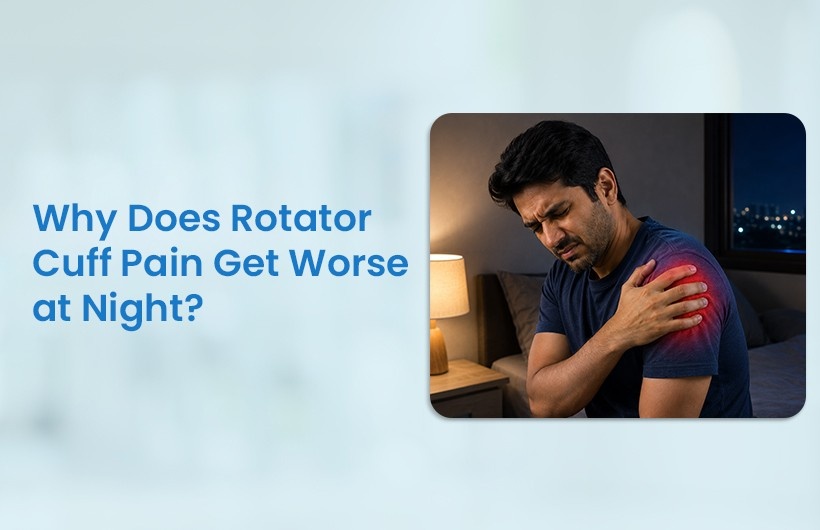
You’ve iced it, stretched it, maybe even taken a painkiller — and the moment you lie down, your shoulder wakes up angrier than it was all day. If you’ve been asking “why does my shoulder hurt more at night,” you’re not imagining it, and you’re far from the only one dealing with this.
Studies on rotator cuff tears have found that most patients report disrupted sleep, with only a small fraction sleeping normally through the night. As part of our rotator cuff treatment work at the clinic, this is one of the most common complaints we hear — often before a patient even has a formal diagnosis.
Why Does Rotator Cuff Pain Get Worse at Night?
It’s not about “sleeping wrong.” During the day, your shoulder stays in motion — walking, reaching, typing — and that movement keeps blood flowing through the tendons and prevents inflammation from settling in one spot.
At night, that changes. Once you lie still, gravity pulls the arm downward and inward, which increases tension on an already irritated or torn tendon. Fluid and inflammatory markers that were being flushed out during daytime movement now pool around the joint instead.
Lying down also removes the postural support your shoulder gets while upright. Without that support, even a small shift in position — arm dropping off the mattress edge or rolling onto the affected side — can trigger a sharp spike in pain that wakes you up.
Is This Just a Bad Sleeping Position, or Something More?
Occasional shoulder discomfort at night can come from simple muscle strain or poor posture during the day. But persistent night pain that’s been going on for more than 2 to 3 weeks, especially alongside weakness when lifting your arm or a popping sensation, points toward a rotator cuff tear rather than ordinary muscle soreness.
The distinction matters because a genuine tear won’t resolve with pillow adjustments alone — it needs an actual diagnosis to know whether rest and physiotherapy will be enough, or whether the tendon needs surgical repair.
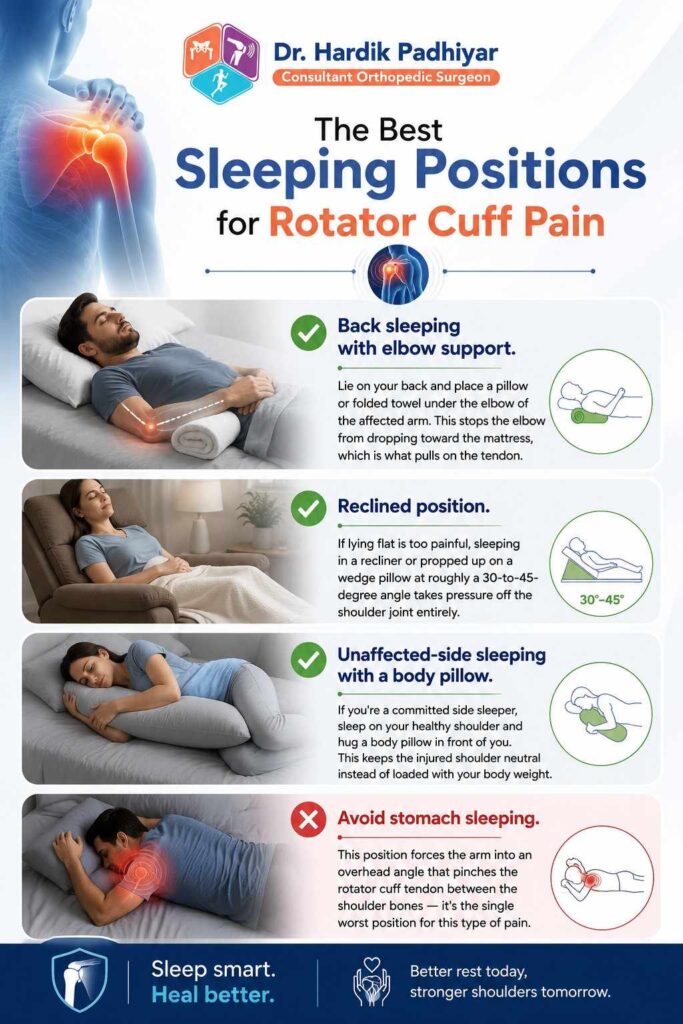
The Best Sleeping Positions for Rotator Cuff Pain
Most patients find real relief just by changing how they position the arm at night. Try these, in order of what tends to help most:
- Back sleeping with elbow support. Lie on your back and place a pillow or folded towel under the elbow of the affected arm. This stops the elbow from dropping toward the mattress, which is what pulls on the tendon.
- Reclined position. If lying flat is too painful, sleeping in a recliner or propped up on a wedge pillow at roughly a 30-to-45-degree angle takes pressure off the shoulder joint entirely.
- Unaffected-side sleeping with a body pillow. If you’re a committed side sleeper, sleep on your healthy shoulder and hug a body pillow in front of you. This keeps the injured shoulder neutral instead of loaded with your body weight.
- Avoid stomach sleeping. This position forces the arm into an overhead angle that pinches the rotator cuff tendon between the shoulder bones — it’s the single worst position for this type of pain.
What to Do in the Hour Before Bed
A few small habits before you lie down can meaningfully reduce how much the pain flares up overnight.
Gentle pendulum stretches — letting the arm hang and swing loosely in small circles — help reduce stiffness without straining the tendon. Applying ice or a warm compress for 15 to 20 minutes before bed can also calm inflammation enough to fall asleep more easily.
If your doctor has approved an anti-inflammatory medication, taking it about an hour before bed, rather than right at bedtime, gives it time to take effect before the pain typically peaks.
When Sleep Adjustments Aren’t Enough
If you’ve tried proper positioning and pre-bed routines for two or more weeks without improvement, that’s a sign this needs an actual evaluation, not more pillow experiments.
See a doctor sooner if you notice:
- Weakness that makes it hard to lift your arm away from your body
- A popping or tearing sensation at the time the pain started
- Pain that’s constant, even during the day and with the arm at rest
- Limited range of motion that’s gotten worse over a few weeks
Dr. Hardik Padhiyar has treated rotator cuff injuries ranging from mild tendon irritation to full-thickness tears requiring arthroscopic repair. An ultrasound or MRI can usually confirm the extent of the injury in a single visit, so you’re not guessing at home for months.
The Bottom Line
A few nights of shoulder discomfort usually aren’t cause for alarm. But if you’ve been rearranging pillows for weeks with no real improvement, that’s your shoulder telling you it needs more than a positioning fix.
If your rotator cuff pain has been disrupting your sleep for more than a couple of weeks, contact us to get it properly assessed, or call us at +91 79903 83550 to book a consultation with Dr. Hardik Padhiyar.
Meet Dr. Hardik, Your Trusted Orthopedic Specialist
If you’re experiencing knee pain, hip pain, shoulder pain, sports injuries, fractures, arthritis, or any bone and joint concerns, get expert guidance from Dr. Hardik Padhiyar and explore the right treatment options today.
Frequently Asked Questions
Q: Can a rotator cuff tear heal without surgery?
A: Smaller or partial tears often improve with rest, activity changes, and a structured physiotherapy program. Larger or full-thickness tears usually need surgical repair for the best long-term outcome.
Q: Is it bad to sleep on the shoulder with rotator cuff pain?
A: Yes, sleeping directly on the affected shoulder adds pressure to already inflamed or torn tendons and tends to make night pain worse. Sleeping on your back or your unaffected side is generally better.
Q: How long does rotator cuff night pain usually last?
A: With proper treatment, many patients see noticeable improvement in night pain within 4 to 6 weeks. Pain that persists beyond that without improvement should be evaluated by an orthopaedic surgeon.
Q: Can a rotator cuff tear get worse if I don’t treat it?
A: Yes. Left untreated, a tear can enlarge over time and lead to muscle weakness or atrophy, making eventual treatment more complex.
Q: Should I use a sling to sleep if my shoulder hurts at night?
A: A sling is sometimes recommended after a recent injury or surgery to keep the joint stable, but it’s not automatically needed for general night pain. Ask your doctor before using one long-term.
This article is for informational purposes only and does not constitute medical advice. Please consult an orthopaedic surgeon for diagnosis and treatment specific to your condition.