

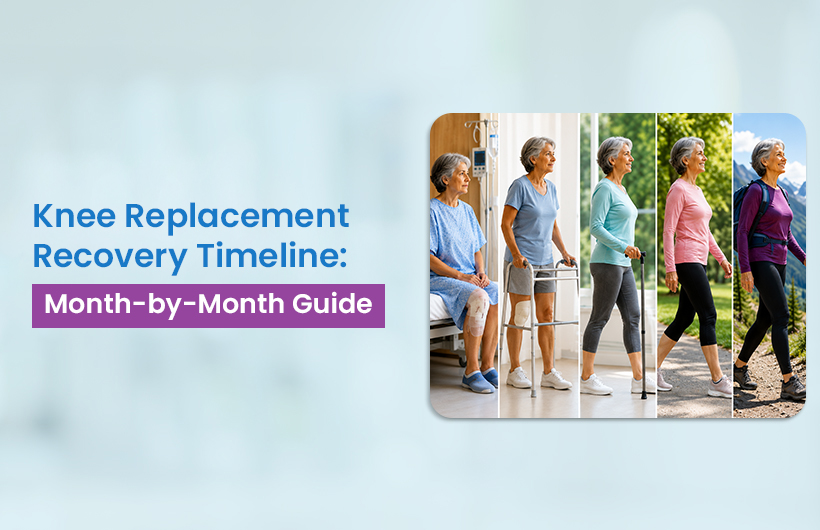
If you or someone you love is preparing for knee replacement surgery, the first question on your mind is probably: “How long will recovery actually take?” Understanding the knee replacement recovery timeline is just as important as the surgery itself. A clear, realistic roadmap helps you prepare mentally, plan your home setup, and stay committed to physiotherapy, all of which directly affect your outcome.
Dr. Hardik Padhiyar Guides every patient through each phase of recovery from the first steps after surgery to return to a full, active life. This month-by-month guide covers exactly what to expect.
Table of Contents
ToggleWhat Is a Knee Replacement and Why Is It Done
Knee replacement surgery (medically called knee arthroplasty) involves removing damaged cartilage and bone from the knee joint and replacing them with a precisely fitted prosthetic implant. The procedure is most recommended when:
- Severe osteoarthritis has worn down the knee joint
- Chronic knee pain limits walking, climbing stairs, or daily activities
- Medications, injections, and physiotherapy no longer provide relief
- The knee has sustained significant damage from injury or rheumatoid arthritis
There are two main types: total knee replacement (the entire joint is resurfaced) and partial knee replacement (only the damaged compartment is addressed). Partial knee replacement often allows for quicker recovery and preserves more of the natural knee. Which option is right for you depends on the extent of your arthritis and your anatomy. Discuss your surgeon.
Why a Clear Knee Replacement Recovery Timeline Matters
Recovery from knee replacement is not a single event; it unfolds in distinct phases over 6 to 12 months. Without a clear picture of the knee replacement recovery timeline, patients often feel frustrated when progress seems slow, or they push too hard too soon and set themselves back.
A structured month-by-month knee replacement recovery guide helps you:
- Set realistic expectations at every stage
- Know which symptoms are normal and which need attention
- Stay motivated during the harder middle weeks
- Communicate better with your surgical and physiotherapy team
The good news: most patients in Ahmedabad and across India report significant pain relief and improved mobility well before the 6-month mark.
Hospital Stay and First Few Days After Surgery
Most patients undergoing total knee replacement spend 2 to 5 days in the hospital. Partial knee replacement Patients often go home sooner.
What happens during your hospital stay:
- Pain is managed with a multi-modal approach oral medications, nerve blocks, and local anesthetic techniques, so you stay as comfortable as possible
- A physiotherapist will help you stand and take your first steps within 24 hours of surgery, usually with a walker or crutches
- You will begin gentle exercises to activate the quadriceps and improve blood circulation
- An ice pack or cold compression device helps control swelling
Early walking is not optional; it is critical. Movement reduces the risk of blood clots (deep vein thrombosis) and kick-starts the healing process.
Before discharge, the team will check that you can safely get in and out of bed, walk a short distance, and manage stairs with assistance.
Week 1–4: Early Healing and Mobility Goals
The first four weeks of knee replacement recovery time are about protecting the incision, managing pain and swelling, and gradually improving your range of motion.
Week 1–2
- Rest is important, but short walks every few hours are encouraged
- Keep your leg elevated above heart level when sitting or lying down
- Ice the knee for 15–20 minutes several times a day
- A physiotherapist will guide you through ankle pumps, heel slides, and straight-leg raises
- Most patients transition from a walker to a cane during this period
Week 3–4
- Swelling begins to reduce noticeably
- You should be able to walk short distances with a cane or without support
- Outpatient physiotherapy sessions intensify bending the knee to 90 degrees, which is a key milestone
- Stair climbing (one step at a time, holding a rail) typically becomes possible
- Most patients can manage basic daily tasks, such as bathing, light cooking, and moving around the house
Pain and stiffness at this stage are normal. Consistency with exercise is everything.
Month 2–3: Building Strength and Reducing Pain
This phase is where most patients notice a meaningful turning point. Swelling decreases significantly, and movement becomes more natural.
What to expect:
- Walking without a cane becomes possible for many patients by week 6–8
- Physiotherapy now includes strengthening exercises for the quadriceps, hamstrings, and hip muscles
- Stair climbing improves, you may be able to alternate legs rather than step-to-step
- Low-impact activities like stationary cycling begin, improving both strength and knee flexibility
- Pain becomes intermittent rather than constant
This is also the period when patients often feel tempted to do too much. Listen to your physiotherapist’s guidance. Overdoing activity too early can cause a flare-up of swelling and delay of progress.
Most patients in Ahmedabad who follow structured physiotherapy programs reach 90–110 degrees of knee flexion by the end of month 3, the range needed for most daily activities.
Month 4–6: Returning to Daily Life and Light Activities
By month 4, most patients are back to most of their everyday activities with significantly reduced or no pain.
Key milestones in this phase:
- Walking longer distances comfortably, including in markets, parks, and community spaces
- Climbing stairs with greater confidence and speed
- Returning to light household work and social activities
- Low-impact exercise, such as swimming, cycling, or yoga (modified) is typically safe
- For patients with desk jobs, most return to work around weeks 6–8; physically demanding occupations may need 3–4 months
The knee will still feel some stiffness in the mornings, and occasional aching is normal, especially after a long day. This is gradually resolved. Continuing physiotherapy exercises at home even after formal sessions end is strongly recommended.
Month 6–12: Long-Term Recovery and Lifestyle Adjustments
Full knee replacement recovery time can extend up to 12 months, particularly for total knee replacement. This does not mean you will be disabled during this time; most patients feel dramatically better, well before 12 months.
What does this phase look like:
- The knee continues to strengthen, and the implant settles into its natural position
- Most residual stiffness and swelling resolve by month 9
- Activities like walking long distances, light hiking, travelling, and moderate recreational activities are fully possible
- High-impact activities (running, jumping, contact sports) are generally discouraged to protect the longevity of the implant. Discuss with your surgeon
- Annual follow-up visits with your orthopedic surgeon are recommended to check implant health via X-ray
A well-functioning knee replacement, combined with an active but joint-friendly lifestyle, can last 15–20 years or longer with the right care.
Local Support and Follow-Up Care in Ahmedabad
If you are based in Ahmedabad or nearby areas such as Gandhinagar, Anand, or Nadiad, having an experienced orthopedic surgeon in ahmedabad who provides hands-on follow-up care is a significant advantage.
Dr. Hardik Padhiyar at AB Plus Hospital on SG Highway, Ahmedabad, is a recognized joint replacement and complex trauma surgeon who performs both total and partial knee replacements using the latest minimally invasive techniques. His approach is personalizing implant selection, and the surgical plan is tailored to each patient’s knee anatomy and level of arthritis.
Post-operative care at Dr. Hardik Padhiyar includes structured physiotherapy guidance, regular follow-up appointments, and direct access to the surgical team throughout the recovery process.
If you are weighing up your options or have questions about what your recovery will look like, the best first step is a consultation.
Ready to Take the Next Step?
If you are living with knee pain in Ahmedabad or the surrounding areas, a consultation is the best way to understand whether knee replacement is right for you and what your personal recovery journey will look like.
Book a consultation with Dr. Hardik Padhiyar at AB Plus Hospital, SG Highway, Ahmedabad, call +91 79903 83550 or visit
Frequently Asked Questions
How long does knee replacement recovery take?
Most patients recover significantly within 4–6 months. Full recovery, including strength and complete mobility, takes up to 12 months for total knee replacement.
When can I walk after knee replacement surgery?
Most patients take their first assisted steps within 24 hours of surgery. Walking without a cane is typically possible within weeks 6–8.
Can I climb the stairs after knee replacement?
Yes, with support, usually within the first 2 weeks. Independent stair climbing with alternating legs is typically achieved by months 2–3.
How long do I need physical therapy after knee replacement?
Formal physiotherapy usually continues for 6–8 weeks after surgery. However, a home exercise program should be maintained for at least 6 months for the best long-term results.
When can I return to work after a knee replacement?
Sedentary or desk-based work: typically, 2–4 weeks. Light physical work: 6–8 weeks. Heavy manual labor: 3–4 months or longer. Discuss your specific job requirements with your surgeon.
How important is physiotherapy in my knee replacement recovery timeline?
It is the single most important factor after surgery. Physiotherapy restores a range of motion, rebuilds strength, reduces stiffness, and prevents complications. Patients who follow their physiotherapy program consistently recover faster and achieve better long-term function.