

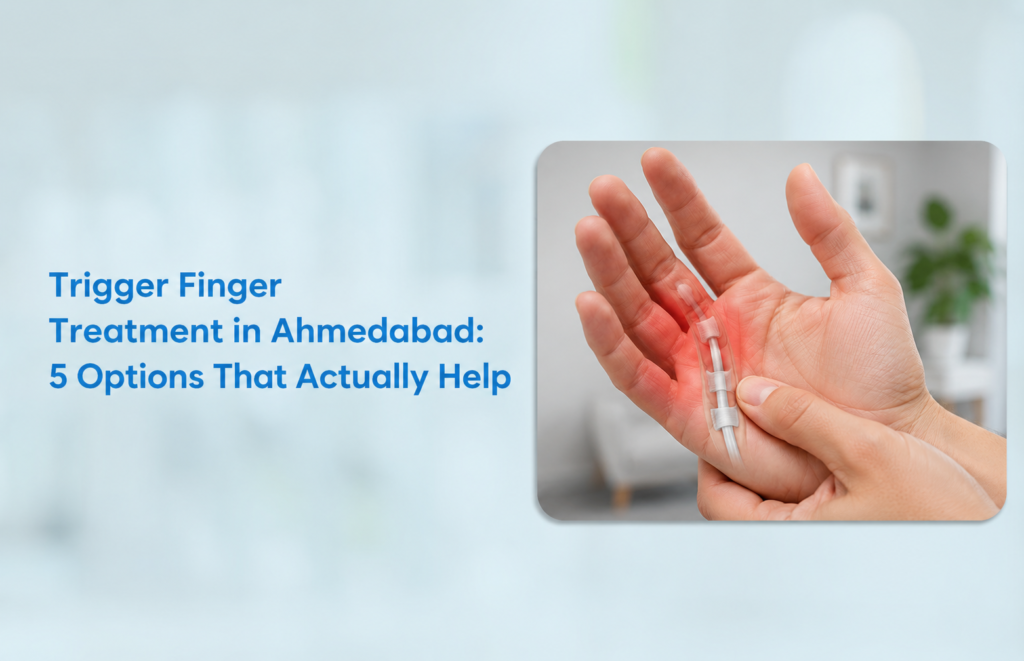
If your finger has been catching, clicking, or locking in a bent position before it suddenly snaps straight, you’re not imagining it, and you’re not alone. This is one of the more common hand conditions I see at my clinic, and the good news is that most cases respond well to simple, non-surgical care. If you’re looking into trigger finger treatment in Ahmedabad, I want to walk you through what’s causing it, the 5 treatment options I use, and when surgery genuinely becomes necessary.
What Is Trigger Finger?
Trigger finger, medically known as stenosing tenosynovitis, happens when the tendon that bends your finger has trouble gliding smoothly through its protective sheath. A ring of tissue called the A1 pulley, located at the base of the finger, can thicken or become inflamed, narrowing the tunnel the tendon passes through.
When this happens, the tendon catches as it tries to slide, causing the finger to lock in a bent position. With enough force, it releases with a snap, which is where the name comes from. Some patients also notice a small tender lump at the base of the affected finger, right in the palm.
It most commonly affects the ring finger and thumb, though any finger can be involved, and it isn’t unusual for more than one finger to be affected at once.
What Causes Trigger Finger?
In my experience, trigger finger tends to show up for a mix of reasons:
- Repetitive gripping activities, such as using tools, cooking, or certain sports
- Underlying conditions like diabetes, rheumatoid arthritis, or gout, which increase the risk significantly
- Being over 40, and more common in women than men
- Prior hand injuries or repeated strain on the tendon sheath
- Occupations that involve frequent hand-intensive tasks
According to the American Academy of Orthopaedic Surgeons, trigger finger occurs in about 2 to 3 percent of the general population, and that risk climbs considerably higher in people with diabetes.
How Do You Know It’s Trigger Finger?
The symptoms are usually easy to recognize once you know what to look for:
- A finger that catches or locks when bending or straightening
- A popping or clicking sensation when the finger releases
- Stiffness, especially first thing in the morning
- A tender bump at the base of the affected finger, in the palm
- In more severe cases, the finger gets stuck in a bent position and needs to be straightened with the other hand
I diagnose trigger finger with a hands-on exam. Feeling for the nodule at the base of the finger and watching how it moves through a full range of motion is usually enough to confirm it. Imaging like X-rays or ultrasound isn’t typically needed unless I suspect an underlying joint issue.
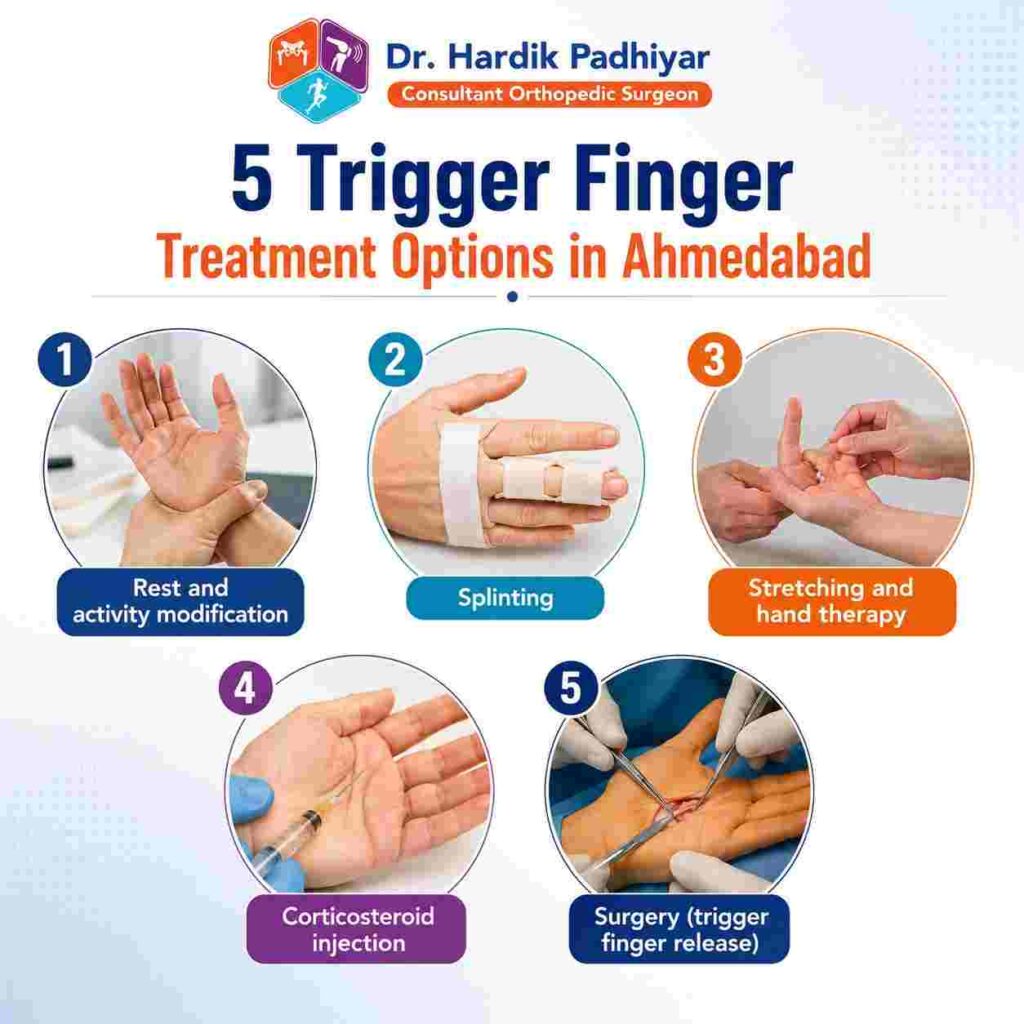
5 Trigger Finger Treatment Options in Ahmedabad
Here’s how I typically guide patients through treatment, starting with the least invasive options first.
1. Rest and activity modification.
Cutting back on the repetitive gripping motion that’s aggravating the tendon gives the inflammation a chance to settle. This alone helps many mild cases.
2. Splinting.
Wearing a splint that keeps the finger in a slightly extended position, especially at night, prevents the tendon from catching and allows the irritated sheath to calm down. Most patients wear it for 4 to 6 weeks.
3. Stretching and hand therapy.
Gentle tendon-gliding exercises, guided by a physiotherapist or hand therapist, keep the tendon moving smoothly and reduce stiffness without straining the area further.
4. Corticosteroid injection.
This is often the most effective non-surgical option. A steroid injection directly into the tendon sheath reduces inflammation and resolves symptoms in roughly 50 to 70 percent of patients after one injection, with a second injection sometimes needed for lasting relief.
5. Surgery (trigger finger release).
If symptoms persist despite splinting and injections, usually after 2 injections have failed, a minor day-care procedure called a trigger finger release is very effective. The surgeon widens the A1 pulley so the tendon can glide freely again. It’s done under local anaesthesia, and most patients go home the same day.
If you’re also dealing with numbness or tingling alongside the locking sensation, it’s worth ruling out an overlapping nerve issue. Our guide on carpal tunnel syndrome treatment covers how that condition presents differently and how the two are sometimes confused.
What Can You Expect from Recovery?
Recovery depends on which stage of treatment you’re at:
- Splinting and activity changes: improvement in 3 to 6 weeks for mild cases
- Steroid injection: relief often begins within 1 to 2 weeks, with full benefit by 4 to 6 weeks
- Post-surgical release: most patients move their finger normally within days, with full recovery and strength returning over 2 to 4 weeks
One thing I always tell patients: don’t wait too long to get it checked. A trigger finger that’s been locked for months can develop stiffness in the joint itself, which takes longer to resolve even after the underlying tendon issue is treated.
When Should You See a Doctor for a Locking Finger?
You should book a consultation if:
- Your finger catches, locks, or clicks regularly, not just occasionally
- The locking is getting more frequent or more severe over time
- You need to use your other hand to straighten the finger
- There’s a tender lump forming at the base of the finger
- You have diabetes or rheumatoid arthritis and notice any of these symptoms, since these conditions raise your risk
Catching it early usually means a faster, simpler recovery.
Conclusion
A finger that locks or catches isn’t something to just live with. Trigger finger is one of the more predictable hand conditions to treat, and most patients get meaningful relief without ever needing surgery. The key is not waiting until the joint stiffens up from months of catching.
If a finger has been locking or clicking for more than a few weeks, contact us to book a consultation with Dr. Hardik Padhiyar, or call us at +91 79903 83550 to get a clear diagnosis and a treatment plan that fits your daily routine.
Meet Dr. Hardik, Your Trusted Orthopedic Specialist
If you’re experiencing knee pain, hip pain, shoulder pain, sports injuries, fractures, arthritis, or any bone and joint concerns, get expert guidance from Dr. Hardik Padhiyar and explore the right treatment options today.
Frequently Asked Questions
Q: Can trigger finger go away on its own?
A: Mild cases sometimes improve with rest and activity changes, but if the locking is frequent or worsening, it usually needs splinting, injection, or eventually surgery to fully resolve.
Q: Is trigger finger surgery painful?
A: The procedure is done under local anaesthesia, so you won’t feel pain during it. Mild soreness at the incision site for a few days afterward is normal and manageable with basic pain relief.
Q: How many steroid injections can I get for trigger finger?
A: Most doctors recommend a maximum of 2 to 3 injections in the same finger. If symptoms return after that, surgery becomes the more reliable long-term solution.
Q: Does trigger finger come back after treatment?
A: Recurrence after splinting or injection is possible, especially if the underlying repetitive activity continues. Recurrence after surgical release is uncommon.
Q: Can trigger finger affect more than one finger at a time?
A: Yes, it’s common, especially in patients with diabetes, to have more than one finger affected either at the same time or over a period of months.
This article is for informational purposes only and does not replace a professional medical consultation. Every case of trigger finger is different, and treatment should be guided by an in-person evaluation with a qualified orthopaedic or hand specialist.